What fills a logistics team’s inbox
Look through a month of enquiries at almost any forwarder, courier or 3PL and the same topics keep coming back:
- Shipment status: where a shipment is, when it will arrive, and why it has not moved.
- Quotes and bookings: rates, transit times, cut-off times and how to book.
- Documents and customs: which documents a shipment needs, and what to do when one is missing.
- Delivery changes: a new address, a new delivery date or a different collection time.
- Proof of delivery and invoices: delivery receipts, charges and payments.
- Claims: goods that arrived damaged, late or not at all.
Most of these have an answer in your own service guides, SOPs and shipment records. That is exactly the kind of work an AI agent does well.
What to automate, and what to keep for people
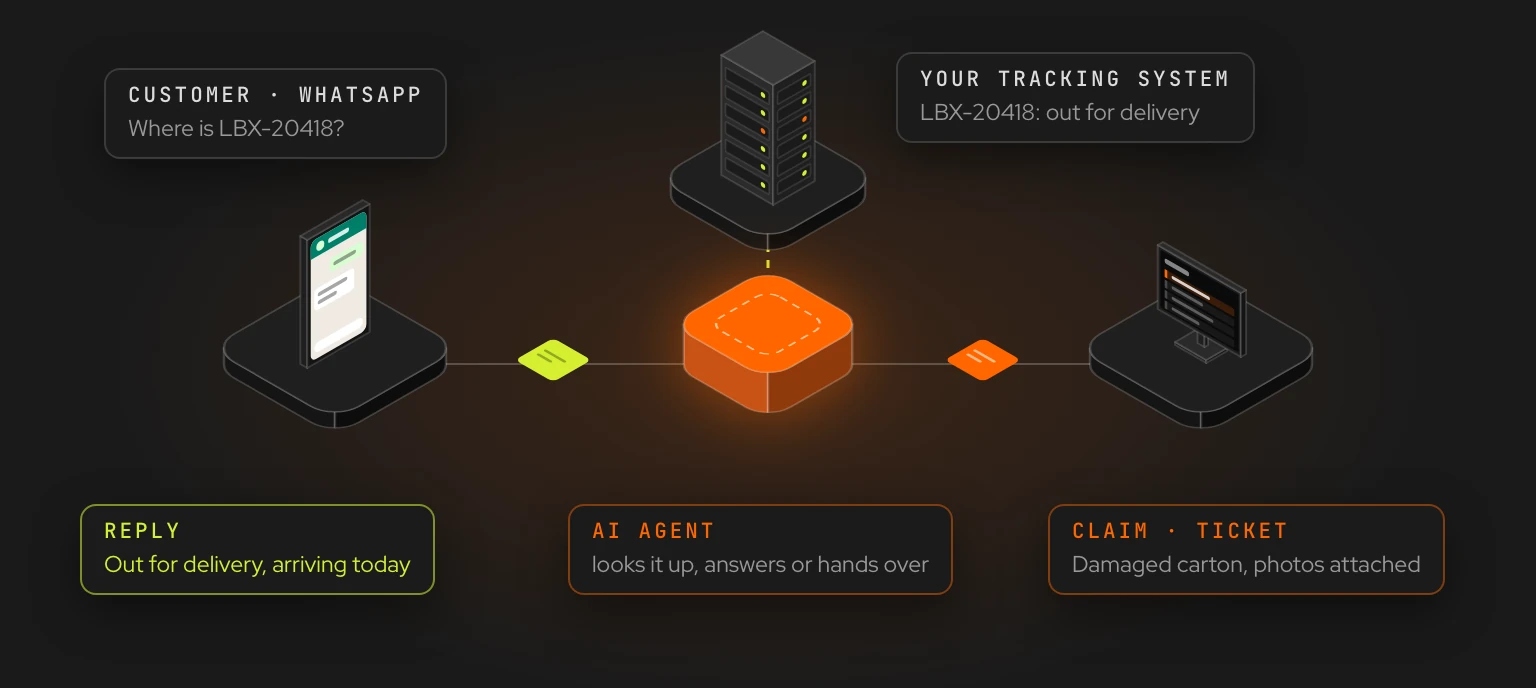
Automate status questions that can be looked up from a shipment reference, questions with a clear answer in your policies (document checklists, cut-off times, service areas), and first replies at any hour.
Keep for people claims and damage, disputes over charges, custom quotes and rate negotiations, and shipments held at customs that need a decision. A well-built agent collects the details first, such as the shipment reference, photos and what happened, then passes the case to your team.
Seven steps to set it up
- Pull three months of enquiries and tag them by topic. This shows what to automate first and gives you a baseline to measure against.
- Build the knowledge base from your own documents: service guides, SOPs, document checklists, cut-off times and service areas. Keep answers separate where the rules differ by service or by country.
- Connect the channels your customers use: website live chat, WhatsApp and email, with one agent and one knowledge base behind all of them.
- Connect your tracking and ticketing systems, so the agent can look up a shipment from its reference and every enquiry becomes a ticket with an owner and a status.
- Set clear handover rules. Send claims, charge disputes, held shipments and unhappy customers to a person, with the conversation and the shipment details attached.
- Test with real enquiries: real shipment references, typos, very short messages and mixed languages. Check that the agent never guesses a status it could not look up.
- Launch on one channel first, often WhatsApp or website chat. Review conversations every week, fix gaps in the knowledge base, then expand.
What to measure
- Resolution rate: the share of enquiries answered without a person.
- First response time: how long a customer waits for the first useful answer, including nights and weekends.
- Handover rate and reasons: what the agent passes on, and why.
- Repeat contacts: customers asking about the same shipment again, a sign that the answer was unclear or the data was out of date.
- Customer satisfaction: a one-question rating after each conversation.
Mistakes to avoid
- Answering status questions without a live connection to your shipment data. An agent that guesses a status does more harm than one that hands over.
- No clear way to reach a person, which leaves a customer with a delayed shipment stuck with a bot.
- Training on generic content instead of your own services, rates and SOPs.
- Launching on every channel at once, before you have seen how real customers ask.
Where SunTech Software fits
We build customer service AI agents for logistics companies: live chat, the AI agent and ticketing in one stack, or connected to the ticketing system you already run. The agent answers on your website and on WhatsApp, is trained on your services, policies and SOPs, and hands cases to your team with the details attached. Our logistics clients include LBS Logistics, a cross-border logistics and supply chain provider. See AI customer service for logistics, or use the form below to book a demo.
Common questions
What can an AI agent answer for a logistics company?
Shipment status from a reference number, document checklists, cut-off times, service areas, delivery changes and other questions your own policies answer, at any hour. It passes claims, charge disputes and custom quotes to your team.
Can an AI agent tell customers where their shipment is?
Yes, when it is connected to your tracking or transport management system. Without a live connection it should hand the question to a person rather than guess.
Which channel should a logistics company automate first?
The one where most enquiries arrive, which is usually WhatsApp or website live chat. Add email and other channels once the first one runs well.
What should an AI agent never do in logistics customer service?
Guess a shipment status it could not look up, promise compensation on a claim, or quote a custom rate. Those go to a person, with the details already collected.